Wastewater a Concern at Proposed New Fire Station in L. Saucon
Lower Saucon Fire Rescue came to the township Planning Commission July 23 looking for a recommendation that would move its new Wassergass Road station one step closer to becoming a reality. The fire company and its representatives left with an unresolved question about where the water will go after the trucks are washed and a tabled application.
The commission ultimately voted to table land development application with the understanding that the fire company’s engineer will soon resubmit an updated plan and return to update the panel at its August meeting.
What Lower Saucon Fire Rescue Wants to Build
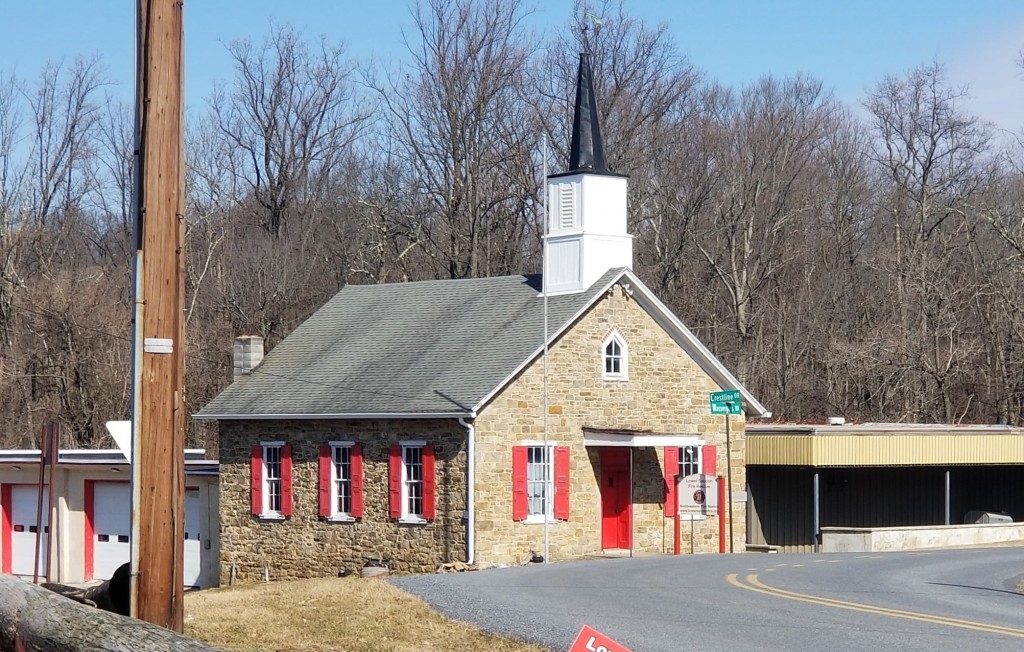
The development proposal covers the fire company’s Southeastern station at 2687 Wassergass Road, in one of the most rural corners of the township. LSFR owns the 15.44-acre property located where Wassergass meets Crestline Drive.
The plan calls for demolition of the existing garage, fire station and social hall, and for their replacement with a 3,600-square-foot fire station and a 3,168-square-foot truck bay directly beside it, according to a project summary prepared by Keystone Consulting Engineers.
“So it’s just going to be a fire station,” said Ian Kauffman of Keystone, who outlined the proposal for the planning commission. The historic one-room schoolhouse on the property, which dates to the 1800s, is not part of the demolition.
The site will keep its existing well and septic system, and impervious surface coverage will drop from 40,209 square feet to 32,050 square feet.
The Industrial Waste Question
The meeting’s central question came from member David Lankewicz, who said he had read the state regulations on fire station wastewater and was concerned about what he found. Under Pennsylvania Department of Environmental Protection rules, he argued, water used for gear and truck washing at a fire station is considered industrial wastewater, which has different handling requirements than ordinary wastewater. He noted that the parking lot drains toward the east branch of the Saucon Creek, coming within about 10 feet of it at one point, and that the existing pavement already encroaches on the 100-foot riparian buffer. He asked the fire company to look at curbs and gutters along the east side of the parking lot and native plantings between the lot and the creek.
“I want to follow the regulations,” Lankewicz said. “I don’t want (community) members coming back and saying, ‘I tested my water. I found oil and grease at 10 parts per million … and I’m a hundred feet away from the fire station and it’s your fault.'”
Kauffman responded that gear washer discharge stays inside the building and gets routed to the septic lateral, and that the garage will have a floor drain to collect truck wash wastewater and send it to the same system. Fire Chief Ty Johnson said the company’s Leithsville firehouse has the same setup, and that gear is washed in a commercial front-loading machine, not via a hose-down in the bay. He acknowledged crews currently wash trucks outside because the existing station has no interior drains.
Kauffman also responded to Lankewicz’s concern, noting that it did not appear in any engineering review letter.
“I’m just not understanding where the requirement for that comes from,” he said.
Township solicitor Steven Goudsouzian defended the commission’s right to raise it anyway.
“It wouldn’t be the first time that some planning commissioner or board member has raised an issue that wasn’t caught by the experts or by the consultants,” Goudsouzian said.
Township engineer Andrew Youssef of Hanover Engineering said his office would help review the matter, and the commission settled on an engineer-to-engineer communication path before the August meeting.
A Second Look at the Septic System
Hanover’s review letter asks the fire company to have the existing septic tank and absorption area inspected. Kauffman said an investigation was supposed to happen earlier in July, and that the expanded scope was forwarded to the contractor the day of the meeting.
Kauffman argued that a hydraulic loading test on a very old absorption area risks blowing out a system that is working fine, and said the tank volume plus a video inspection should be enough to prove capacity.
Johnson said there are two 3,000-gallon tanks in the ground dating to roughly 1973 or 1974, that they were dug open, pumped and inspected about eight or nine years ago with no problems, and that the drain field shows none of the wet spots or bright green patches that signal failure.
The flow math points the same direction. Because Chapter 73 of the township’s zoning code–which regulates sewage disposal–has no design flow standard specifically for a fire station, Kauffman said he is calculating it as a part-time workers’ construction camp, or roughly 35 gallons per day for each of about 10 people. He estimated the old station and social hall combined had an output closer to 2,000 gallons per day. Youssef told Kauffman to keep township sewage enforcement officer Chris Taylor of Hanover Engineering in the loop on the investigation.
Driveways, Sight Lines and the Schoolhouse
Both driveways will remain in their current general locations, but the wide, informal aprons will be narrowed and channelized under the proposal. Kauffman put the proposed Wassergass driveway at 34 feet and the Crestline entrance at 30 feet. No road widening is proposed, which Kauffman said would be impractical. Johnson, who also works as a township road crew foreman, called the change a safety upgrade.
“Where the truck bays are now, we have a really bad line of sight problem,” Johnson said. “Where the proposed truck apron is on Wassergass, the line of sight’s a lot better.”
The station is being sized for the department’s largest apparatus, a ladder truck of roughly 42 feet, though Johnson said that truck will not be housed there. He described it as a building plan for future use, since no one knows what that end of the township will look like in 25 years. A tanker, an engine and a brush truck will be housed at the station, with the longest of those at 34 feet.
The schoolhouse drew its own round of questions. Johnson said the fire company offered it to the township for relocation to a park and has no plans for it otherwise. The attached furnace room will come down with the station, and the opening into the basement will be sealed.
“We own it, so by rights we could tear it down. It’s not on a national registry or anything like that,” Johnson said. “We don’t want to do that. I grew up out there. That’s been there for the 50 years that I was there, and it’s a staple in the neighborhood.”
Youssef raised a point about the paved pull-off in front of the schoolhouse, close to the Crestline intersection. Under the plan, only the gravel portion will be removed and restored to grass, while the paved section remains. Youssef asked why the whole thing isn’t coming out and suggested the fire company consider putting a no-parking sign there. Johnson said the pull-off exists because the schoolhouse has served as a polling station during elections, and that with no electricity or water connected to the building after demolition, that use may end anyway.
Commission Signals Support on Open Space Fee Waiver
Kauffman also asked for a read on the township’s open space requirement, which lets a land developer either dedicate open space or pay a fee. He calculated the fee at roughly $39,720. The township has already waived submission fees for the fire company, it was noted.
“These guys are volunteers,” Kauffman said. “They’re not making any money or (developing the land) for profit…”
Lankewicz said he would move to recommend waiving the fee.
Other members agreed, pointing to the redevelopment of an existing site and the decrease in impervious surface coverage that would result from the project. Kauffman added that the leftover land is largely unusable and probably would not qualify as viable open space to dedicate.
The commission took no formal vote, since Kauffman had not yet submitted a written waiver request. Goudsouzian said the fee waiver is ultimately a decision for township council, and that the panel would vote on the full waiver list when the fire company returns.
What Happens Next
Goudsouzian framed the commission’s approach as giving the fire company some leeway, telling Kauffman to resubmit the best plan he can and use the time until the next meeting to sort out the wastewater question. If it is resolved to Hanover’s satisfaction, the commission indicated it is prepared to grant the waivers and move the application along to township council.