Playing to Their Strengths: The Benefits of a 4-3 Over a 3-4 for the Philadelphia Eagles
There’s been a lot to talk about for Philadelphia Eagles fans recently. The flurry of events beginning with the firing of Chip Kelly and snowballing from there produced what may be seen in the future as one of the best moves of the 2016 offseason—the hiring of Jim Schwartz as the new defensive coordinator.
There’s been a lot to talk about for Philadelphia Eagles fans recently. The flurry of events beginning with the firing of Chip Kelly and snowballing from there produced what may be seen in the future as one of the best moves of the 2016 offseason—the hiring of Jim Schwartz as the new defensive coordinator.
The Eagles’ previous DC, Billy Davis, was run out of town for his uncreative blitzes, inability to consistently generate pressure on the quarterback and head-scratching decisions, such as leaving a rookie corner on an island with Calvin Johnson in the Lions game. Davis ran a 3-4 defense, which is typically better suited to creating confusion and executing exotic blitzes in order to make it difficult for the opposing quarterback to know where pass rushers are coming from and, in fact, how many. The problem is, Davis’ scheme got exposed for all the weaknesses of a 3-4 while failing to take advantage of its strengths.
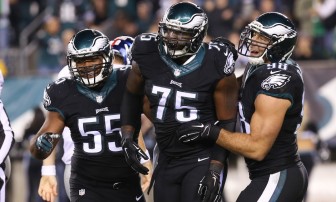
The hiring of Schwartz should have a very positive effect on the Eagles’ D. Schwartz has an excellent track record as a DC. For example, in 2014 he led the Buffalo Bills to a league-leading 54 sacks while his defense ranked 11th against the run and 3rd against the pass, giving it an overall ranking of 4th in the league.
With Schwartz’s arrival, it is expected that the Eagles will be moving to a 4-3 base defense. However, the successful DC brings his own spin on the vanilla scheme, often lining up the defense in what is known as a “Wide-9” alignment. The name refers to the positioning of the defensive linemen, who will usually line up wide of the 9-technique, outside the tight end. This alignment is more effective at setting the edge and forcing the run inside, daring the back to beat the interior linemen. Given that the Eagles’ interior linemen—Bennie Logan and Fletcher Cox—have been playing exceptionally well as of late, this should be a beneficial adjustment in terms of stopping the run—something the Eagles had issues with in 2015.
Further, some would argue that the 4-3 is better suited to the Eagles’ personnel than a 3-4. Brandon Graham, who played outside linebacker in Davis’ 3-4, was drafted as a defensive end out of Michigan, and is still more naturally built for the position. The scheme switch would see Bennie Logan as the nose tackle, eating up blocks and paving the way for Fletcher Cox, a fearsome pass rusher, to have more one-on-one matchups to exploit. Vinny Curry, another player with exceptional pass rushing skills and the physical tools of a defensive end, only got to see limited playing time in the 3-4, but he would always ensure the other team knew he was on the field by making plays. Curry switching from a 3-4 OLB to a 4-3 DE would best utilize his skillset, allowing him to be on the field more often and terrorize opposing quarterbacks.
In 2015, Billy Davis had discussed cooking up some packages that might allow three inside linebackers to be on the field at once (typically in a 3-4 base there are two OLBs and two ILBs on the field). In Schwartz’s 4-3, the Eagles would be able to do this on every snap. While the ILBs as a group—specifically Mychal Kendricks and Kiko Alonso—had a down year, the talent is there. Kendricks has repeatedly shown what he can do on the field in previous years, while Kiko’s 2013 rookie campaign was one for the record books. Add sophomore linebacker Jordan Hicks, who had a stellar rookie year before he was sidelined by an injury, into the mix, and even a partial return to form for both Kendricks and Kiko will have the rest of the league quaking in its boots at the thought of the Eagles’ LB group.
In this alignment, each linebacker could take on a role that would play down his weaknesses and bring out his strengths. Kiko at weak-side linebacker, or WLB, would be able to show off his coverage skills. Hicks at middle linebacker, or MLB, would be the quarterback of the defense, able to utilize the full extent of his football intelligence. Finally, Kendricks playing at strong-side linebacker, or SLB, could show off his strengths in stopping the run and blitzing the QB.
I’ll leave it at that. Myself and other more—*ahem*—“professional” football analysts can discuss schemes and positions and blitzes and strengths and weaknesses ‘till the cows come home, but there is only one thing that will definitively prove the success or failure of Jim Schwartz as a DC—the 2016 Philadelphia Eagles season.
For your edification, here is what the Eagles’ base alignment might look like in a 4-3:
DL: Curry——–Cox——–Logan——–Graham
LB: Kendricks—–Hicks—–Alonso
Vincent Behe is a Saucon Valley resident and Eagles fan. He is an undergraduate student at Lehigh University in Bethlehem, where he is majoring in history.
Author