Data Center Tax Break Could Cost PA Billions in Lost Revenue
by Kate Huangpu and Stephen Caruso of Spotlight PA
Spotlight PA is an independent, nonpartisan, nonprofit newsroom producing investigative and public-service journalism that holds power to account and drives positive change in Pennsylvania. Sign up for our free newsletters.
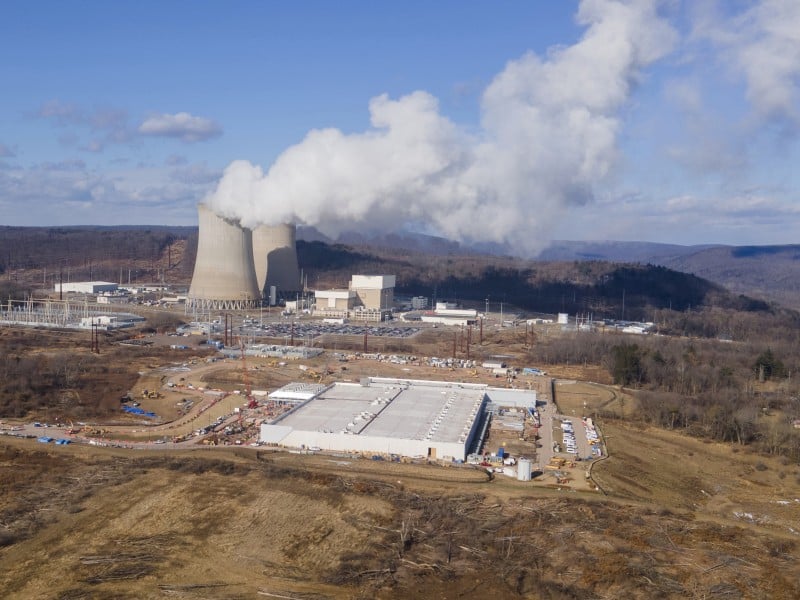
HARRISBURG — As data centers spread and draw backlash across the state, new figures are emerging about their potential long-term costs. The Shapiro administration’s latest budget estimates show Pennsylvania could lose out on about $2 billion in revenue by mid-2031 due to a tax break that some lawmakers want to repeal.
Data center developers and their supporters say the sales tax exemption strongly incentivizes building the facilities in Pennsylvania, which they argue will generate billions of dollars in economic activity and tax revenue.
But local activists and legislators who oppose the tax breaks argue it’s a costly giveaway to an industry dominated by some of the country’s largest and most profitable corporations when the state is hungry for revenue. Some studies indicate that economic incentives have little influence on where businesses locate their projects or don’t deliver broad long-term benefits.
Pennsylvanians across the state have raised concerns about proposed data centers and their potential impacts on energy prices, water usage and pollution. Some have fought their local governments to prohibit developers from building campuses in their own communities. In a recent poll, 42 percent of Pennsylvanians said they do not want one built in or near their community.
Colby Wesner, a pediatrician from Montour County, is part of that opposition. He lives near a proposed data center, and says “there are already enough incentives in Pennsylvania,” like the state’s natural gas resources, and lawmakers don’t need to give developers another.
“When you’re talking about the Amazons of the world, they have a stupid amount of money,” Wesner told Spotlight PA. “Schools need support, farmers need support, conservation and environmental efforts need support, and when you’re giving trillion-dollar companies tax relief, it just doesn’t make sense.”
State Rep. Greg Vitali (D., Delaware) introduced a bill that would repeal the tax exemption, singling out Amazon and Microsoft as companies that don’t need the break. But he told Spotlight PA he’s uncertain the measure will pass the state House, let alone clear the Senate and the governor’s desk.
“The governor seems to be pretty strong on data centers, and our House Democratic leadership would probably take his lead,” Vitali said.
Democratic Gov. Josh Shapiro, as well as legislative leaders in the Democratic-controlled House and GOP-controlled Senate, did not directly comment on whether they would support such a change when asked by Spotlight PA.
Unknown costs
Under a nearly five-year-old change, data center developers can dodge the state’s 6 percent sales tax on purchases related to building and maintaining the tech hubs, including for the expensive servers and other equipment.
Only companies that meet certain financial benchmarks are eligible. In counties with larger populations, for instance, companies must eventually create new investment of at least $100 million and at least 45 new jobs, according to program guidelines.
The actual cost to the commonwealth is unknown, the Department of Revenue has acknowledged. The Shapiro administration says the law establishing the exemption program does not include a reporting requirement for either the buyer or seller at the time of purchase.
But the governor’s latest budget proposal estimated that the exemption cost the state $41 million last fiscal year. And the price tag is expected to balloon in the years ahead, with the estimated lost tax revenue growing from $188 million in the upcoming fiscal year to $517 million by the fiscal year ending in mid-2031.
The projections acknowledge the industry’s growth, as tech giants and small firms alike have scrambled to set up server farms to feed artificial intelligence’s computing needs and growing demand for cloud storage.
At the same time, state lawmakers are debating the newest proposed spending plan and how to cover rising costs for human services and education, which consistently outpace annual tax revenues.
Shapiro’s budget proposal does include some action on data centers. He listed broad transparency, energy, employment and environmental asks for developers. Meeting them would give the firms access to benefits, “including speed and certainty in the permitting process and our available tax credits,” he said in his February address. His budget plan assumes the sales tax break will remain in place.
Developers argue the exemption has enabled the growth of an industry that employs thousands of construction workers and contractors, with benefits trickling down into adjacent communities.
“When you look at what data centers are providing, this is essential infrastructure. Without data centers, you don’t have a 21st-century economy,” said Dan Diorio, vice president of state policy with the Data Center Coalition — the industry’s trade group. Its members include Amazon Web Services, Google and Microsoft.
Pennsylvania, he added, has features that make it attractive to developers and tech firms: proximity to large population centers, plentiful electricity, available land and a skilled construction workforce.
But with a majority of states offering a similar tax exemption, Diorio argued that eliminating Pennsylvania’s would turn away investors and be a “barrier to entry” for data center development.
Kasia Tarczynska, senior research analyst at Good Jobs First, a nonprofit research organization that tracks economic development subsidies, disagrees about the benefits of this type of exemption. Her research shows these incentives don’t provide a return on investment for states and localities.
Outside of building the facilities, data center jobs are often focused on security, maintenance or administration, according to Tarczynska. Those permanent workers are often employed by local contractors, rather than a big tech firm, which can reduce the quality of those jobs.
The sharp increase in Pennsylvania’s projected revenue loss, she said, “shows there’s a huge boom in the industry.” Tarczynska added that other states with a similar tax exemption have underestimated the amount of revenue they would lose.
For example, Georgia last May calculated it would lose $327 million in revenue this fiscal year, according to the Atlanta Journal-Constitution. But new data shows that number is closer to $2.5 billion.
Tarczynska said Pennsylvania’s estimated revenue losses could be similarly inaccurate because “the state government doesn’t have enough information about how much the industry is using this tax exemption.”
“This is really bad for accountability and for governments’ ability to plan their budget,” she said.
Although the lack of reporting requirements in Pennsylvania obscures the true cost of the tax exemption, the companies that benefit are required to keep detailed records, including payroll journals for the Department of Revenue to examine, the Shapiro administration told Spotlight PA.
At least 35 other states, including neighboring Ohio and New York, offer similar exemptions or other economic incentives to data centers, according to Tarczynska’s research.
Pennsylvania’s budget documents reflect the uncertainty around the subsidy’s full cost. Estimates for the upcoming 2026-27 fiscal year have swung widely.
In 2022, Gov. Tom Wolf’s administration projected the exemption would cost $89 million in the 2026-27 fiscal year. Last year, the Shapiro administration projected a lower cost for that same year: $45 million. But now, the Shapiro administration has significantly revised its estimate and projects the cost will be $188 million in the upcoming fiscal year.
Asked about the different estimates, the Shapiro administration said the program involves an emerging industry that has changed dramatically in a short period.
The tax break used to be a refund provided to qualifying businesses, and was capped at $5 million when it first passed in 2016. Lawmakers in 2019 raised the cap to $7 million.
But as part of the 2021 budget deal, the legislature rewrote the program, nixing the cap and making the program a tax exemption rather than a refund, which limited the state’s ability to track its full cost.
At the time, some lawmakers opposed the change, arguing the state was giving handouts to giant corporations. Supporters said it would help create jobs and sustainable revenue.
At a news conference after signing the budget in late June 2021, Wolf said he pressed for the change to the tax break, arguing it would attract construction jobs to Pennsylvania.
“I’m sure it came from other people too,” Wolf, a Democrat, said, “but I think it was a good idea, so I’ll take credit for it.”
A spokesperson for the Shapiro administration did not directly comment on whether the governor would support altering or eliminating the tax exemption, instead reiterating that the governor’s plan ensures that companies that meet responsible development standards “can unlock benefits from the Commonwealth.”
State Senate Majority Leader Joe Pittman (R., Indiana) also did not directly address whether he would support keeping this tax exemption for data centers. But in a statement to Spotlight PA, he said “balancing economic growth initiatives with predictable state revenues is key to ensuring the long-term fiscal stability of our Commonwealth.”
Leadership for state House Democrats did not comment in time for publication.
The law has been amended in recent years — in 2024, lawmakers banned cryptocurrency producers from taking advantage of the tax break. The bill behind that ban was introduced by Vitali, the legislator who wants to repeal the data center tax exemption.
Regarding his latest push to change the sales and use tax exemption, Vitali raised concerns about the environmental costs of data centers and said it’s no longer “appropriate” to incentivize their development.
“They seem to be springing up just fine,” he said.
BEFORE YOU GO… If you learned something from this article, pay it forward and contribute to Spotlight PA at spotlightpa.org/donate. Spotlight PA is funded by foundations and readers like you who are committed to accountability journalism that gets results.