Senior Apartment Proposal Hits Roadblock with Hellertown Zoners
A proposed 43-unit senior housing development at 30 Bachman Street hit a dead end March 18 after the Borough of Hellertown Zoning Hearing Board deadlocked 2-2 on a critical use variance needed to move the project forward.
The application for zoning relief filed by Exchange 21 LLC sought to convert a vacant 0.96-acre lot in the borough’s industrial zoning district into a three-story, age-restricted residential complex for residents 55 and older. The hearing lasted roughly four hours and elicited testimony from three expert witnesses and pushback from residents of the neighborhood.
Board Chair Thomas Dietrich and one other member voted against the use variance. Board members Donald Mills and Melissa Hutchison voted in favor. Vice Chair Kristina Fish was absent–a fact Dietrich acknowledged on the record after the tie result.
Because the motion failed to carry a majority, the use variance was effectively denied, halting the project in its tracks.
Exchange 21 LLC’s Five Variance Requests and How the Board Ruled
The applicant, represented by land use attorney John VanLuvanee of Eastburn and Gray, P.C., came before the board seeking five forms of zoning relief, which Zoning Officer Terri Fadem described at the outset of the hearing.
Here is how each variance request was decided:
Request 1 — Use Variance (Section 450-15(A)(1)): Permit housing for the elderly in an industrial zoning district. Denied on a 2-2 tie vote. The motion failed for lack of a majority.
Request 2 — Building Coverage Variance (Section 450-15(E)(5)): Allow 47 percent building coverage where 40 percent is the maximum. Unanimously approved.
Request 3 — Truck Loading Space Variance (Section 450-20(B)(2)): Permit a loading space measuring 12 feet by 49 feet where 12 feet by 53 feet is required. Unanimously approved, conditioned on an appropriate use of the property.
Request 4 — Parking Variance (Section 450-20(A)(2)): Permit 43 off-street parking spaces where 87 are required. Unanimously denied.
Request 5 — Density Variance (Section 450-11(D)): Permit 43 elderly housing units on the property. Unanimously denied.
Zoning Hearing Board Solicitor Robert Nitchkey had noted before the remaining votes that, with the use variance dead, there was little practical purpose in proceeding through the rest. The board voted on all five requests for the record, however.
What the Applicant Was Proposing
Architect Gene Berg Jr. of Gouck Architects in Allentown served as lead witness for Exchange 21 LLC. He said he has been involved with the project since 2021.
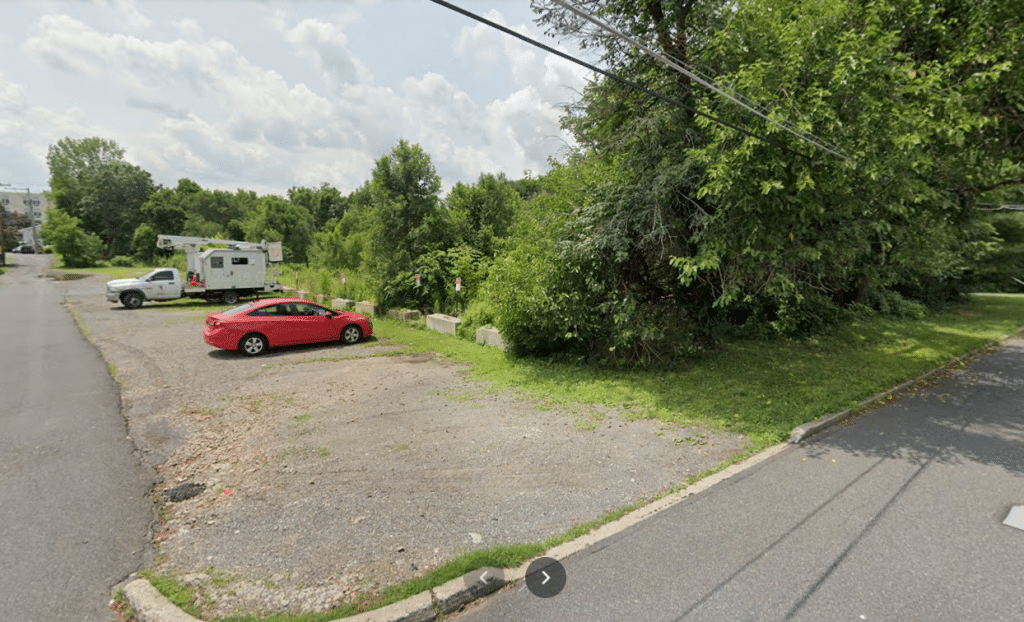
Berg described the property at 30 Bachman Street as a vacant, unimproved lot bounded by Bachman Street to the north, Oak Street to the east, Furnace Street to the west and a building formerly used by an antique business to the south. The lot is in the borough’s narrow industrial zoning district but abuts the R-2 medium density residential district across Bachman Street and the mixed-use district across Oak Street.
The proposed building would contain 27 one-bedroom apartments at 747 square feet each and 16 two-bedroom units at 1,132 square feet each. It would stand three stories tall–scaled down from a four-story plan that was initially presented to the Planning Commission in 2021.
Berg testified that the building would feature an underground parking deck with 40 spaces, plus three exterior electric vehicle charging spaces, for a total of 43 parking spots. Two interior spaces would be handicapped-accessible near the elevator. A 24-foot-wide two-way driveway off Furnace Street would provide access to the underground garage.
As part of the project, Exchange 21 LLC offered to dedicate roughly 7,430 square feet of its property–about 17.7 percent of the total acreage–for right-of-way widening on Bachman Street, Oak Street and Furnace Street, bringing all three to 26-foot widths. Berg testified that without those dedications, building coverage on the lot would be 38.7 percent, or below the 40 percent maximum.
Parking a Battleground Issue
The parking question dominated much of the hearing. Under Hellertown’s current zoning ordinance, which was updated last year, the parking requirement for housing for the elderly is two spaces per unit plus one per employee. With 43 units and no employees, 87 spaces were required.
Berg testified that the previous ordinance required just one space per five units, which would have meant only nine required spaces for this project.
Transportation engineer Peter Terry, president of Benchmark Civil Engineering Services in Allentown, testified as the applicant’s traffic expert. He told the board three Pennsylvania study sites showed an average peak parking demand of 0.61 spaces per dwelling unit. Applied to 43 units, that translates to a peak demand of roughly 26 spaces, which would leave the proposed lot with an estimated 17-space surplus.
Terry acknowledged under questioning from Nitchkey and board members that the data he referenced was based on a limited number of sites, did not differentiate by bedroom type and did not identify whether the study communities had vehicle restrictions or provided shuttle transportation for residents.
Nimita Kapoor-Atiyeh, administrator and president of Saucon Valley Manor and its related facilities, testified as the third witness. Kapoor-Atiyeh said her family would own and operate the proposed Bachman Street building through Exchange 21 LLC. She testified that Saucon Valley Manor units 2 and 3 currently house 72 residents, out of whom only 14 have vehicles.
Neighbors Push Back on Parking and Fire Access
Several Bachman Street-area residents testified against the project, raising concerns about parking overflow, fire truck access and notification procedures.
Andrea Weida Tinsman, who lives across from the proposed site, said she moved to Hellertown for a suburban feel and does not want to look at an apartment building. She argued there would be 40 usable spots if the three EV-designated spaces are excluded from the general count, and that parking is already tight on her street.
“I don’t know a household on our street that has one vehicle,” Tinsman said, noting that she and her husband own four vehicles.
Tinsman also questioned how a fire truck could navigate from Thomas Avenue onto Furnace Street given parked cars and tight corners. She said she learned about the hearing only because someone knocked on her door the previous Saturday afternoon, rather than from a posted sign, Facebook notice or other public notification.
Matt Marcincin, who lives near the site, raised concerns about parking spillover on special occasions and challenged the idea that street widening would meaningfully help the neighborhood’s parking situation. A borough councilman, Marcincin said that before Exchange 21 LLC acquired the property an industrial landscaping company operated there for roughly 10 years, with minimal impact on neighbors.
Eugene Noel, who lives near the proposed parking deck entrance, said he has a daughter with a disability who uses a handicapped parking placard on the street directly in front of their house. He expressed concern that residents of the new building with their own handicapped placards would take that spot.
His daughter, Rose Noel, testified that there are three handicapped parking spaces on Bachman Street–none designated to specific individuals–and that adding 43 senior housing units would increase competition for those limited spots. She said no sign was posted on Bachman Street advertising the hearing and that she learned about it only because someone came to their door.
Don Werkheiser, who lives about five blocks south of the site, argued that the parking analysis underestimated real-world demand. He pointed out that many people over 55 still work, with both spouses driving, and that visitors during holidays and family gatherings would quickly overwhelm the garage.
Fire truck access emerged as a sticking point during deliberations. Berg had presented a turning template prepared by a site engineer showing that a 43-foot fire truck could navigate a left turn into the widened portion of Furnace Street from Bachman Street, but board member Ken Solt said the borough’s fire apparatus would not fit on the surrounding streets.
“We have a million-dollar Quint. There’s no way it’s going to fit down there,” Solt said.
Mills echoed the concern, expressing doubt that a fire truck could navigate the intersection of Thomas and Furnace streets; a section of road south of the applicant’s property that would not be widened.
The Board’s Reasoning and What Comes Next
VanLuvanee, the applicant’s attorney, had argued in his closing statement that the 0.96-acre lot is too small, too close to residential areas and lacks sufficient access for meaningful industrial use. He also called the parking question a “red herring,” and pointed to Kapoor-Atiyeh’s real-world data from Saucon Valley Manor showing just 14 vehicles among 72 residents.
The board was not persuaded, however. After the votes, Dietrich–citing a legal standard for granting a variance–said board members reached a consensus that the project as proposed was “not the least modification necessary to afford relief.”
The Hellertown Zoning Hearing Board’s next meeting is scheduled for April 2026.
Author