How Agencies Under Gov. Josh Shapiro’s Control Do–and Don’t–Cooperate with ICE
by Stephen Caruso of Spotlight PA
Spotlight PA is an independent, nonpartisan, nonprofit newsroom producing investigative and public-service journalism that holds power to account and drives positive change in Pennsylvania. Sign up for our free newsletters.
PHILADELPHIA — Agencies under Democratic Gov. Josh Shapiro’s control continue to cooperate with federal immigration authorities as the governor publicly criticizes ICE for its violent actions in Minneapolis and secretive warehouse purchases in Pennsylvania.
While there are limits, collaboration still happens through a handful of key avenues, a Spotlight PA review of Shapiro administration policies and statements shows. Advocates for immigrants say even this limited cooperation threatens their communities.
A Pennsylvania State Police policy that restricts the agency’s ability to enforce federal immigration law, adopted under Shapiro’s Democratic predecessor, still allows troopers to share information with ICE.
Federal immigration enforcement agencies have access to personal information that Pennsylvanians have shared with the commonwealth, such as driver’s license numbers and headshots.
And state prison officials honor requests by ICE to temporarily hold individuals who have “been convicted and sentenced for crimes by courts.” In one recent case, ICE picked up a central Pennsylvania man cleared of a murder charge as soon as he was released from a state prison.
These policies, all of which existed before Shapiro was in office, now matter for the estimated hundreds of thousands of undocumented immigrants in Pennsylvania who could face deportation under the Trump administration’s sweeping crackdown, as well as for immigrants’ families and communities.
While President Donald Trump and his administration have highlighted enforcement against people who commit crimes, 73 percent of those detained by ICE during a recent period had no criminal convictions, according to the Cato Institute, a libertarian think tank.
Shapiro has not hidden that the state works with ICE, nor has he promised new limits on existing cooperation. After an ICE officer in Minnesota shot and killed Renee Good in January, Shapiro said on MS Now that the state works with “law enforcement at every level to keep communities safe.”
But he has also increasingly criticized federal immigration efforts, saying the Trump administration uses government for “pure evil” after agents killed Alex Pretti in Minneapolis. And he denounced ICE’s secretive purchase of a warehouse in Berks County for a detention center, saying “it just creates more chaos, confusion and fear.” A spokesperson for the governor told Spotlight PA the administration is evaluating other steps to protect Pennsylvanians from “unconstitutional and immoral attacks on our rights and freedoms.”
For immigration advocates, the statements aren’t enough. They have called on Shapiro to end collaboration with ICE, limit the agency’s access to law enforcement databases and prohibit information sharing by state prisons.
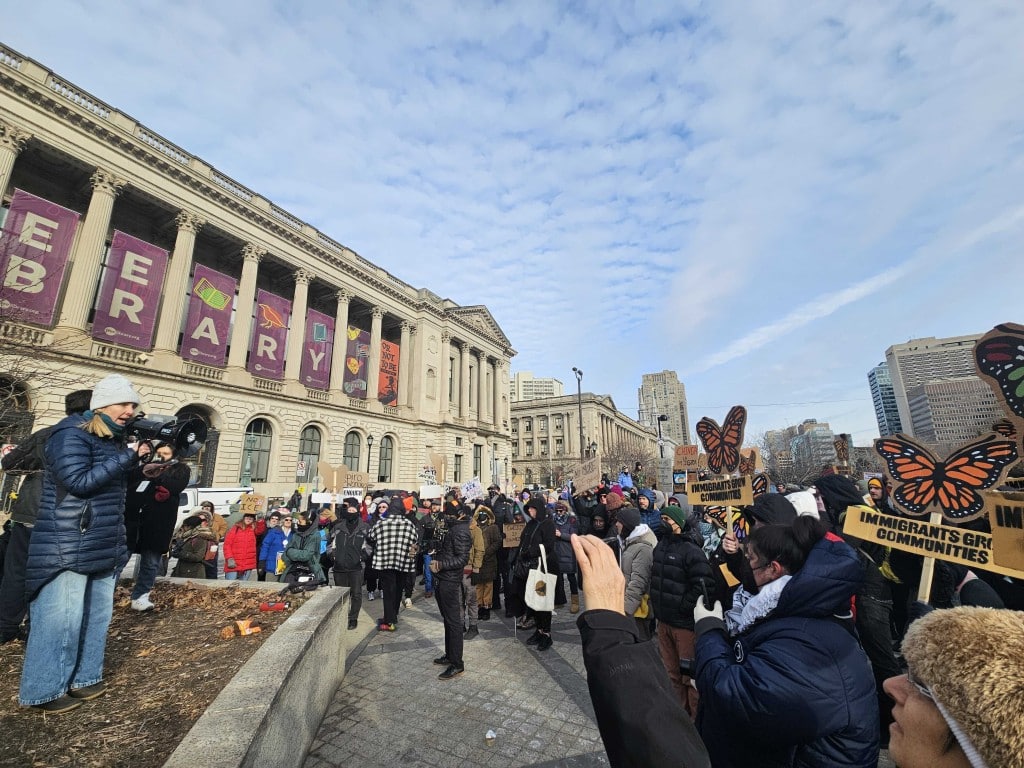
“Shapiro, there is no gray area,” one speaker said at a 200-person protest outside a January event to promote the governor’s new memoir. “Now is the time.”
Here’s what you need to know:
What Pennsylvania State Police can do
Under a four-year-old policy, State Police cannot engage in immigration enforcement. However, the agency can tell federal authorities if personnel pull over or otherwise interact with an undocumented person.
Speaking at an event to celebrate the launch of his memoir, Shapiro argued his administration draws clear boundaries.
“We do not do ICE’s work for them here in Pennsylvania,” Shapiro said, according to the Capital-Star. “Our State Police [don’t] ask for people’s status, and we do not share any of that information with the federal government.”
But the state’s written policy on immigration enforcement is less definitive, and legal experts say it allows State Police to assist with ICE operations and share information with federal authorities.
The policy says State Police personnel may “not stop, search, investigate or attempt to arrest” someone based on their immigration status, citizenship or nationality — and that an “immigration detainer cannot form the independent basis for any detention or arrest.”
The policy was adopted in response to a lawsuit by the ACLU of Pennsylvania, which claimed State Police racially profiled Latinos to enforce federal immigration laws and violated their civil rights. The Wolf administration authored a new policy, which is still in place, as part of a settlement agreement.
To encourage people to report crime and cooperate with investigations, everyone “must feel secure” that interacting with State Police, “ordinarily, will not lead to an immigration inquiry,” the policy says.
Exceptions remain. Vanessa Stine, an ACLU of Pennsylvania staff attorney who focuses on immigrants’ rights, told Spotlight PA that “while it’s true that the policy says, generally, [State Police personnel] shouldn’t be asking people about immigration status, in the event that they happen upon that information, that information could be shared by an officer with ICE.”
The policy says that if an officer learns in the course of an encounter that an individual, including a vehicle operator, passenger, victim or witness, is a foreign national, and then the officer shares that information with federal immigration authorities, they are required to file a report with State Police.
In 2025, there were 50 instances of State Police officers contacting ICE after such an encounter, according to the Shapiro administration, which argued this outreach is rare. State Police conducted hundreds of thousands of traffic stops the year before.
The policy also doesn’t prevent State Police from assisting federal immigration enforcement from, for instance, providing security or traffic control around operations, Stine said.
Stine said such a blurring of the lines could lead to a deterioration in community relations between State Police and immigrant communities, because “community members aren’t going to see the difference” if uniformed state officers are nearby when ICE arrests are ongoing.
In a letter responding to immigrant advocates’ concerns, the Shapiro administration did not address State Police enforcing security cordons.
Instead, the letter said State Police do “not and will not make operational decisions based on ICE priorities — the department’s priority is the safety of Pennsylvania residents, and will make all operational decisions to ensure public safety.”
What information does the state share with ICE?
Another key concern for immigration and privacy advocates is that Pennsylvanians’ personal information — including date of birth, address, height, eye color and headshots — can be accessed by ICE without a warrant.
This information is available through the Pennsylvania Justice Network, or JNET, a state-run law enforcement database. Eleven state agencies and commissions, as well as county agencies and judicial systems, “make their information available” through JNET. Most critically, the system includes information provided to PennDOT.
Caitlin Barry, a Villanova University professor of law and director of a legal aid clinic, said ICE is among those that can access this “incredibly secretive system.”
Barry discovered ICE’s access while working on a report for a legal clinic at the university and a coalition that supports giving driver’s licenses to undocumented immigrants with privacy and data protections. The report, based on open records requests, was published in 2020, before Shapiro became governor.
It also found that the photos available to ICE can be run through facial recognition software. Federal immigration authorities have expanded use of the software in recent months, which Barry argues raises civil liberties concerns.
A separate 2024 report from the ACLU, which Barry also contributed to, examined federal records the Department of Homeland Security uses to “make the case for deportation of an undocumented person”; it found 16 instances “where ICE used JNET to identify people for arrest” between 2016 and 2020.
The report noted a 2020 arrest in which ICE used JNET to “search photos and select a person for arrest who had a scheduled probation appointment in Lehigh County. ICE officers went to the probation office and arrested the person.”
Barry said law enforcement’s access to this database, including ICE, is unfettered, and the “concern is that no one is assessing whether ICE is making legitimate searches related to criminal investigations, or just using it to target anyone they want.”
“There’s no review. You self-certify. It’s not as if someone requests access, and then that request is getting evaluated,” Barry said.
Immigration advocates want the Shapiro administration to allow ICE to access JNET only if the agency has a criminal warrant. That would significantly limit ICE’s ability to use it for immigration enforcement, Barry said, as violating immigration law is usually a civil rather than criminal offense.
Policymakers in a handful of states, such as New York, New Jersey and Washington, have already made similar moves to block ICE’s access, Barry said.
The Shapiro administration disagreed with Barry’s characterization that access is unfettered.
It also said that JNET searches cannot use criteria like immigration status, country of origin, race or ethnicity, and that each time an outside law enforcement agency accesses these types of systems, the state logs and tracks it.
The administration has also said “there are legitimate investigations” involving undocumented immigrants that “require immigration enforcement agencies to seek access to information contained in Commonwealth-run databases.” And even if the state added new restrictions, federal law enforcement officials might still be able to access this information through other databases or agencies, it added.
Advocates have also raised concerns about federal immigration officials accessing other data, including through state public benefit programs. The administration has said that it has gone to court to block federal agencies from unlawfully acquiring Pennsylvanians’ personal information.
While some immigration advocates have called for the administration to prioritize legislation to allow undocumented people to obtain driver’s licenses, the Shapiro administration has expressed concerns that the federal government might try to obtain the information necessary to implement such a policy.
What can state prison officials do
In October 2025, ICE apprehended a Centre County man whose murder conviction had recently been overturned by a judge.
The man, Subramanyam “Subu” Vedam, had been in Pennsylvania Department of Corrections custody and had an active detainer over unrelated drug charges.
Correctional facilities across the country may hold some individuals ICE is interested in for up to 48 hours to allow federal agents a chance to apprehend them; this is known as a detainer. Advocates want Shapiro to end communications and collaborations between state prisons and ICE.
A spokesperson for the Shapiro administration said the Department of Corrections, which runs state prisons, “honors active detainers with respect to individuals who have been convicted and sentenced for crimes by courts and [are] eligible to be incarcerated in Pennsylvania prisons.”
The Shapiro administration said state prisons cannot and will not hold someone with an ICE detainer beyond 48 hours, but did not address whether the agency otherwise shares information on those it detains.
Access to state buildings
Advocates have also called on Shapiro to block ICE arrests in state facilities without a judicial warrant or order.
A Shapiro spokesperson said the administration has “not received any reports of federal authorities arresting individuals on immigration charges inside a Commonwealth facility.”
Last year, the Shapiro administration issued a policy for state agencies on how to handle requests from federal immigration agents. It places some limits on access.
The policy says all law enforcement officers can access public spaces in commonwealth facilities, such as DMVs or public benefits’ offices, and may access nonpublic areas “only when legally authorized to do so.” It lays out how workers should proceed and who they should contact when law enforcement officers request access to nonpublic spaces or when they provide a warrant or other documentation.
The administration also issued guidance for school districts on how to develop policies around immigration enforcement.
ICE arrests in courts — which don’t operate under Shapiro — are another concern for immigration advocates. Courts in Pennsylvania are overseen by the state Supreme Court and its administrative arm.
Stacey Witalec, spokesperson for the state court system, told Spotlight PA that “ICE, like any state or federal law enforcement agency, may access public areas of judicial facilities while performing official duties. However, judicial functions and administration must always take precedence, and law enforcement activities should never disrupt the administration of justice.”
Witalec added that the courts don’t track immigration detentions within court buildings, although such detentions have reportedly occurred at or around courthouses in Philadelphia and the Lehigh Valley.
Advocates have also called on Shapiro’s administration to never lease a state facility to ICE. The Shapiro administration says it doesn’t and will not do so.
BEFORE YOU GO… If you learned something from this article, pay it forward and contribute to Spotlight PA at spotlightpa.org/donate. Spotlight PA is funded by foundations and readers like you who are committed to accountability journalism that gets results.