Meet ElliQ, the Gamechanging AI Robot for Seniors: Bar Talk with Eric Bartosz
Aug. 21 is National Senior Citizens Day, and it’s easy to picture the holiday with a Hallmark card in mind, along with cake, grandkids and a nice lunch out. But this year, I want to use the occasion to talk about something less sentimental and a lot more consequential: how technology is rewriting what it means to age well, on your own terms, in your own home.
I came across a fascinating New York Times story about an 85-year-old woman named Jan who lives alone on the Washington coast.
Spoiler alert, it turns out she has a roommate and it’s a robot. The piece opened with a line that stuck with me, that the first people living alongside artificially intelligent robots turned out to be octogenarians, not tech bros in Silicon Valley. A year after Jan brought the robot into her home, her resting heart rate had dropped a few beats and her doctor noted her short-term memory had actually improved on cognitive testing.
That robot is called ElliQ, made by a company called Intuition Robotics. After reading the story I wanted to learn more, and I reached out to the company’s CEO, Dor Skuler. It was a highly interesting conversation and Dor, along with his team, are doing amazing work that enables seniors around the world to continue living their best lives with independence. I wanted to share what I learned as I think it could be significant to anyone with aging parents, anyone thinking about their own future or anyone who just cares about the epidemic of loneliness affecting older adults in our own communities.
The problem is bigger than most of us realize. Skuler’s team frames it around three converging crises: the isolation and loneliness of older adults (researchers have compared its health impact to smoking roughly 15 cigarettes a day), a national shortage of an estimated 800,000 paid caregivers and the fact that nearly 70 percent of Medicare hospitalizations involve patients managing multiple chronic conditions at once. None of us is immune to these forces; most of us will either live through one of them or watch a parent live through it.
This is more than Alexa with a friendlier face. My mom, who passed away in 2023, lived alone as a senior in her later years. I remember how often she’d talk to her Alexa, not to check the weather or set a timer, but simply because she wanted a bit of conversation and didn’t want to “bother” anyone by calling. I shared that with Dor on our call, and it’s exactly the gap he built ElliQ to fill.
What struck me most in the conversation was how deliberately un-transactional the design philosophy is. Where a device like Alexa waits for a command, ElliQ initiates: checking in on your mood, nudging you to take a short walk, reminding you about a medication or just striking up a morning conversation on her own. She remembers what you told her last week. She has a consistent personality that becomes familiar over time. It’s the difference between a tool you talk at and a presence that talks with you, which matters enormously for someone who, like my mom, would rather chat with a device than feel like a burden to the people she loved. Skuler put it simply: other companies are building the body of AI, or the brain; his team is trying to build the heart.
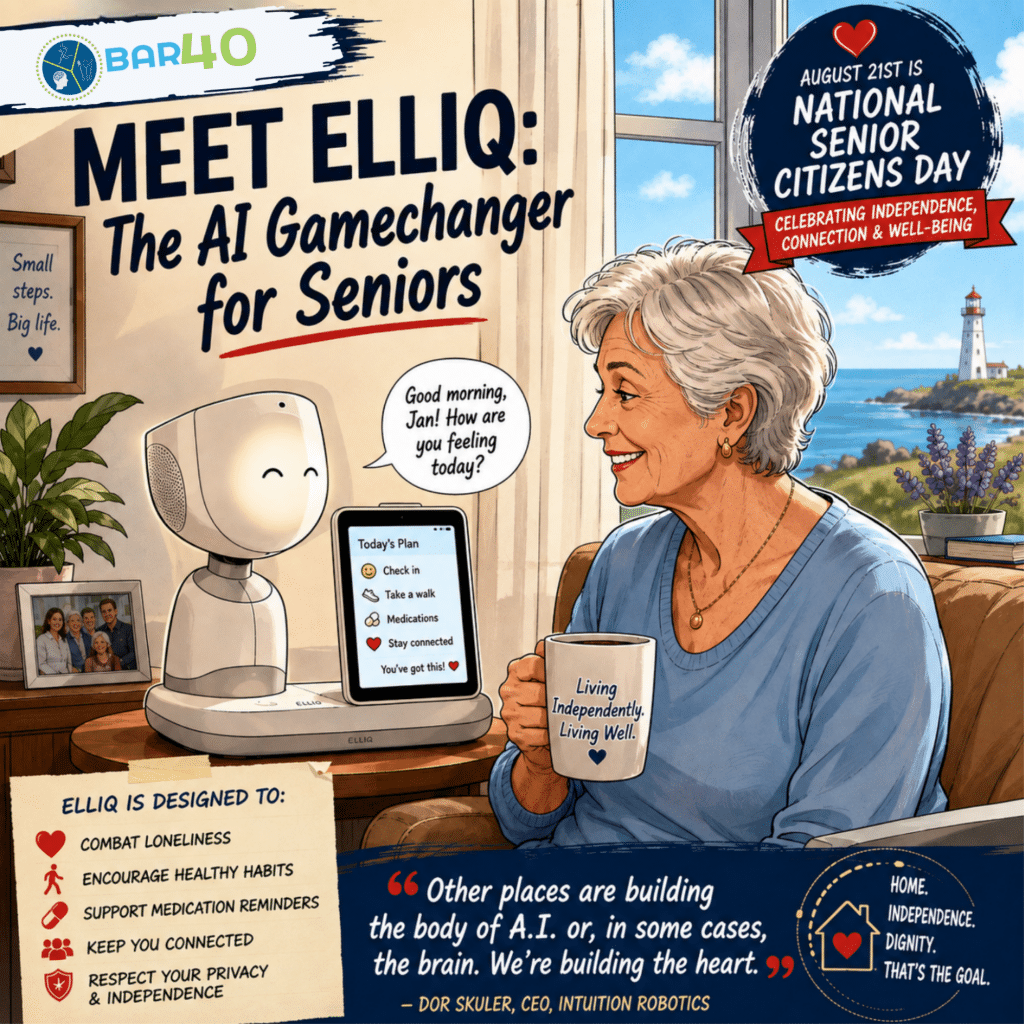
The results aren’t just anecdotal. In a peer-reviewed study out of Duke and Cornell (published in the Journal of Aging Research & Lifestyle, ScienceDirect, ElliQ, an AI-Driven Social Robot to Alleviate Loneliness: Progress and Lessons Learned), 90 percent of users said ElliQ helped them feel more connected to the outside world, and a similar share reported it improved their quality of life. A separate two-year case study found a 53 percent reduction in hospital admissions and a 67 percent drop in re-institutionalization rates among participants; numbers that matter enormously when you consider what a single avoided hospital stay means for a family, let alone a healthcare system.
What I appreciated most, though, was how the company thinks about trust and control. ElliQ isn’t marketed as a surveillance device for worried adult children; it’s built around the older adult’s own autonomy. She only listens for her wake word, doesn’t record background conversation and only shares updates with family if the user opts in. Family members get a companion app where they can suggest a reminder or a wellness goal, but the person using ElliQ always has the final say on their own screen. It’s support, not control, which is exactly the distinction that determines whether a technology like this actually gets adopted by the people it’s meant to help.
For anyone skeptical, perhaps thinking “robot companion for grandma” sounds like a solution in search of a problem, I get it, but I would also suggest you check out the ElliQ site and learn more about this groundbreaking innovation. I came out of my conversation with Dor thinking about seniors in my life, and also my future senior self and what future version of ElliQ will exist in the next 30 years. The goal of Intuition Robotics is not to replace human connection. It’s to fill the quiet and potentially lonely hours between visits, to catch the small changes (a missed medication, a lower energy level, a few days of silence) before they become a crisis, and to give adult children some peace of mind without turning into full-time monitors of their parents’ lives.
So this National Senior Citizens Day, my challenge to you is simple: don’t just celebrate the seniors in your life; ask them what independence actually looks like for them, and whether there’s a tool, a habit or a conversation that could help them hold onto more of it. Sometimes the biggest gift isn’t a visit. It’s making sure they’re not alone in the hours between them.
Author