Steve Miller Was Right: Bar Talk with Eric Bartosz
Fun fact: this past April I turned 50. Depending on where you are in your own life’s journey, that may seem old, or it could seem young. Perhaps it’s close to where you are now. We could call that ‘middle age,’ although technically that assumes we’ll see our 100th birthday. Possible, but statistically unlikely, which means that the finish line is closer than the start line. I’m fine with all of that, and I’m more concerned with biological and cardiovascular age than chronological age, since those tend to be the yardsticks that determine how much life we have in our days versus how many days we have in our lives.
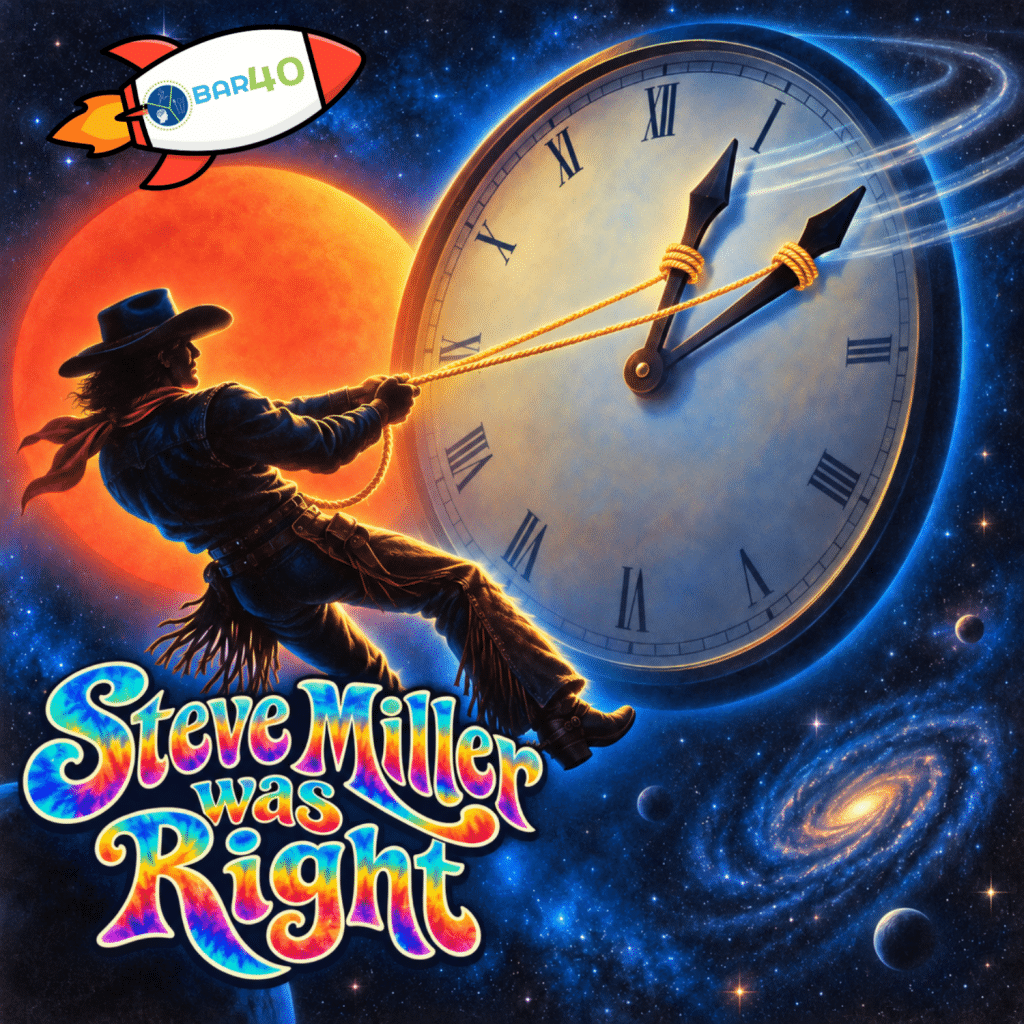
What I find much more interesting than any specific number, and a topic I have been thinking about more, is the broader subject of our perception of time; specifically the well-known phenomenon of ‘the older we get, the faster it goes.’ In this regard, Steve Miller had it right with his 1976 lyric about how ‘time keeps on slipping into the future.’
Big 10-4 on that, good buddy!
The passage of time is relentless, as we know, but why does our perception of that slippage accelerate as we age, making months and years seem to speed up? If we can gain some clarity around that, we take a big step towards slowing it down, if that’s something we would like to do. Personally, I’m fascinated with the superpower of being able to mentally pump the brakes and let the good times roll a little slower.
First the why:
Here’s the good news: you’re not imagining it, and it’s not just nostalgia talking. Neuroscientists have actually caught this phenomenon happening inside the brain, and the culprit turns out to be exactly what you’d guess if you thought about why childhood summers felt endless: novelty, or the lack of it.
A study published this past fall in the journal Communications Biology gives us the clearest look yet. Researchers pulled brain scans from 577 people ages 18 to 88, all of whom had watched the same eight-minute clip from an old Alfred Hitchcock Presents episode while lying in an fMRI machine. Using an algorithm that tracks “neural states,” essentially the brain’s way of flagging that something new just happened, the team found that younger brains created far more of these states over the same eight minutes. Older brains lingered in each state longer and created fewer of them overall, particularly in the regions tied to perception and memory.
Fewer flagged moments, in hindsight, adds up to less felt time. When everything is new, as it is for a kid, the brain works overtime tagging almost every moment as worth remembering. A summer afternoon becomes 50 distinct little events instead of one long blur called “Tuesday.” As we age, routine takes over, and the brain gets efficient, no longer bothering to tag the commute, the meeting, the errands, because it’s seen it all before. Efficient for getting through the day, but also gas on the fire for burning up time without any distinct memories of it.
A second piece of math works against us, too. A year is 20 percent of a five-year-old’s life. At 50, that same year is 2 percent. Our internal clock doesn’t run on a fixed scale; it runs on comparison. A year at five is a huge chunk of everything you’ve experienced. A year at 50 is a drop in a much bigger bucket. Novelty and numbers are big pieces of the time perception puzzle.
Live Science covered the study well, if you want the full summary: Why time seems to move faster the older we get.
Now the how:
If novelty is the lever, the fix isn’t complicated, even if it takes some intention to pull it. And this isn’t just a working-years exercise. If anything, retirement hands you more raw material to work with, since the calendar opens up right when routine would otherwise start to close in.
- Break the pattern on purpose. A different route on your walk, a different chair at the table, something new on the menu. None of it needs to be a big deal. The brain just needs a reason to pay attention again.
- Learn something new, on a schedule. A language, an instrument, a skill you never had time for. This one doesn’t require tuition or a classroom. Sites like Coursera, edX and Khan Academy offer real university-level courses for free, your local library likely has free access to language apps and lecture series, and YouTube alone could keep you learning a new hobby for the rest of your life without spending a dime. Learning forces the brain to encode richly because it doesn’t yet know what to ignore. Better still, take a class in person at a community college or a local rec center, where the learning comes bundled with the next point.
- Make the social piece non-negotiable. Of everything on this list, this is the one I’d protect first. The researchers behind the study pointed to meaningful social interaction and shared joy as possibly the biggest lever of all, more than novelty for its own sake. A standing coffee with a friend, a weekly game night, a volunteer shift, a grandkid’s Tuesday pickup. Isolation is routine’s best friend, and routine is exactly what makes time disappear. If retirement has shrunk your circle, this is the piece worth rebuilding and focusing on first.
- Travel, even locally. New geography is one of the most reliable novelty triggers there is. A town 20 minutes away that you’ve never actually walked around will do plenty of the same work as a plane ticket.
- Put the phone down during the good parts. Divided attention is the enemy of encoding. You can’t stretch time you didn’t notice in the first place.
- Savor it while it’s happening. Don’t wait for the memory to form on its own. When you’re in a good moment, be mindful of the details: the taste of the meal, the sound of the grandkids in the next room, the view from the rail trail. That deliberate pause, sometimes called savoring, is one of the simplest ways to signal to the brain that this moment matters and deserves to be encoded, rather than letting it slide by on autopilot.
None of this stops the clock, but it changes how a month and a year feels once you look back on them, and that’s the part we have some control over. Think of it as traction control to stop slippage!
Author