It’s Not What to Be, It’s How to Be: Bar Talk with Eric Bartosz
Plenty of good stuff happens in May; for example, beautiful weather, celebrating moms and Memorial Day, but if you’re a senior, the highlight is likely your upcoming graduation. Whether you’re finishing high school or college, this month will likely mean your years of hard work are celebrated with a cap and gown and some photos holding your well-deserved diploma.
Another reality of graduation in 2026 may be anxiety and stress about what the future holds for career paths and opportunities. Everywhere we look, there is another news story, post or video about how AI is taking jobs away, and you have a better chance of winning Powerball than landing the job you are hoping for at a company you want to work for.
First off, don’t give that negative hype any real estate in your head. Bad news sells, and in the attention economy we’re living in, media companies (especially social media) are incentivized to push doom-and-gloom messaging as often as possible to drive engagement.
There are plenty of very positive indicators for people starting their careers, now in or in four years, that are not getting nearly as much attention. Employers are actually planning to hire more graduates this year, with recent projections showing a rebound in entry-level hiring after a cautious couple of years. Check out this article in Inc. from last month to read more about the rebound in hiring.
At the same time, research from firms like Boston Consulting Group shows that AI is expected to reshape far more jobs than it replaces. In other words, the roles are changing, not disappearing.
We’re also seeing entirely new opportunities emerge. Companies are hiring people not just to build AI, but also to guide and communicate around it to drive human results. That includes roles for people with backgrounds in business, communications and even philosophy. Most of these positions didn’t exist five years ago and are now among the fastest-growing and most valuable in the market. This is one example of AI creating rather than eliminating opportunities, but the bigger headline is that the World Economic Forum has presented data showing that 65 percent of kids entering school today will end up working in jobs that don’t even exist yet. Think about that fact the next time you’re feeling stressed. Most of the jobs that will provide you a paycheck in the years to come do not even exist yet. While that statistic from the WEF is forward-looking, the reality is we’re already seeing that shift happening in real time.
I’ve been repeating this message in the MBA classroom for years now: AI may not take your job, but someone with comparable technical knowledge and AI expertise will almost certainly take it. The advantage is moving toward people who know how to use the tools to accelerate the speed and effectiveness of their knowledge and unique perspective. AI can draft, analyze and automate, but it still relies on human judgment, creativity and leadership to make it meaningful.
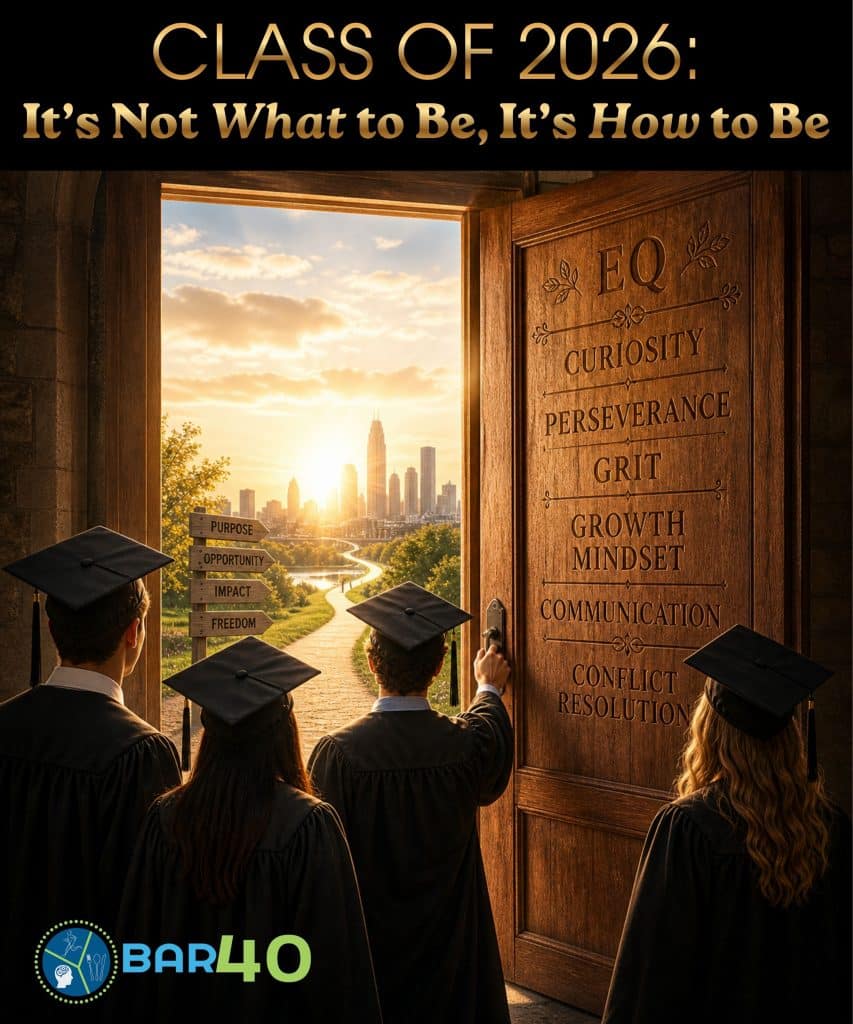
Perhaps most importantly, you don’t need to know what you want to be in the future, but you can certainly decide how you want to be. Developing your skills around emotional intelligence, including self-awareness and management, social awareness and relationship management, is something in your span of control that you can take ownership of.
One of the fundamental reasons, aside from the fact that the core principles of EQ are what will help you become the ultimate version of yourself, is the fact that these skills are becoming the most sought-after by employers.
That same World Economic Forum I mentioned earlier publishes a Future of Jobs report that consistently ranks skills like analytical thinking, resilience, flexibility and leadership at the top of what employers say they will prioritize through 2030. Notice what is missing from that list: technical mastery of any specific software. This makes sense, as while the tools change and become obsolete, the human skills continue to compound.
Here is the practical part. The four pillars of emotional intelligence are not abstract concepts you read about once and forget. They are habits you build through daily repetition, the same way you trained for a sport or studied for an exam.
Self-awareness is the starting point. It is knowing what you are good at, what drains you and what irritates you, and how to be aware of your emotions without being hijacked by them. The graduates who get this right are the ones who can answer “what do you actually want?” in an interview without sounding rehearsed, because they have thought about it and know themselves.
Self-management is what happens when life punches you in the mouth. You will not get every job. You will have a boss who makes no sense. You will send an email you regret. Self-management is the ability to feel that frustration and still respond like the professional you want to become, instead of the version of you that just wants to vent.
Social awareness is reading the room. It is noticing when a teammate is struggling, when a customer is hesitating or when your manager has had a rough morning. AI can analyze data faster than you ever will. It cannot pick up on the energy in a conference room or sense when a colleague needs five minutes of your attention.
Relationship management is where the first three come together. Building trust, navigating disagreement, collaborating across personalities and influencing people without authority are the skills that separate good employees from indispensable ones. They are also, not coincidentally, the skills that get people promoted. In a recent poll, 75 percent of HR directors reported that they promote and hire more on EQ than IQ. (Fun fact: TalentSmart data shows that 90 percent of top performers have high EQ, and people with high EQ earn an average of $29,000 per year more than people with low EQ.)
If you are a graduate reading this, I will leave you with a few final thoughts. The technical skills you have worked hard to earn matter, and AI fluency will absolutely give you an edge as you start out. But the people who build long, meaningful and prosperous careers are the ones who keep investing in their interpersonal skills. These include how well they communicate, collaborate and manage conflict, as well as how they reveal themselves through traits such as curiosity, a growth mindset and grit. These are skills you can develop with daily practice, and the best time to start was yesterday. (The second-best time is today.) It’s worth noting here that while there are plenty of things that are out of control, these are development areas that are entirely in your power to manage. Action alleviates anxiety, and in stressful times, a powerful antidote is channeling energy into the focal areas where you do not need to rely on others.
As teams become smaller, EQ skills are being prioritized more than ever, giving you more control over your destiny, regardless of what any algorithm or hiring manager does. A perfect starting point is the book ‘Emotional Intelligence 2.0’ by Dr. Travis Bradberry. Each book comes with a unique code to access an online test that provides a customized report of your baseline and development opportunities.
Congratulations, Class of 2026. The future is yours, and it’s very bright!
Author