Hellertown Zoners Grant Appeal of Controversial Rezoning Decision
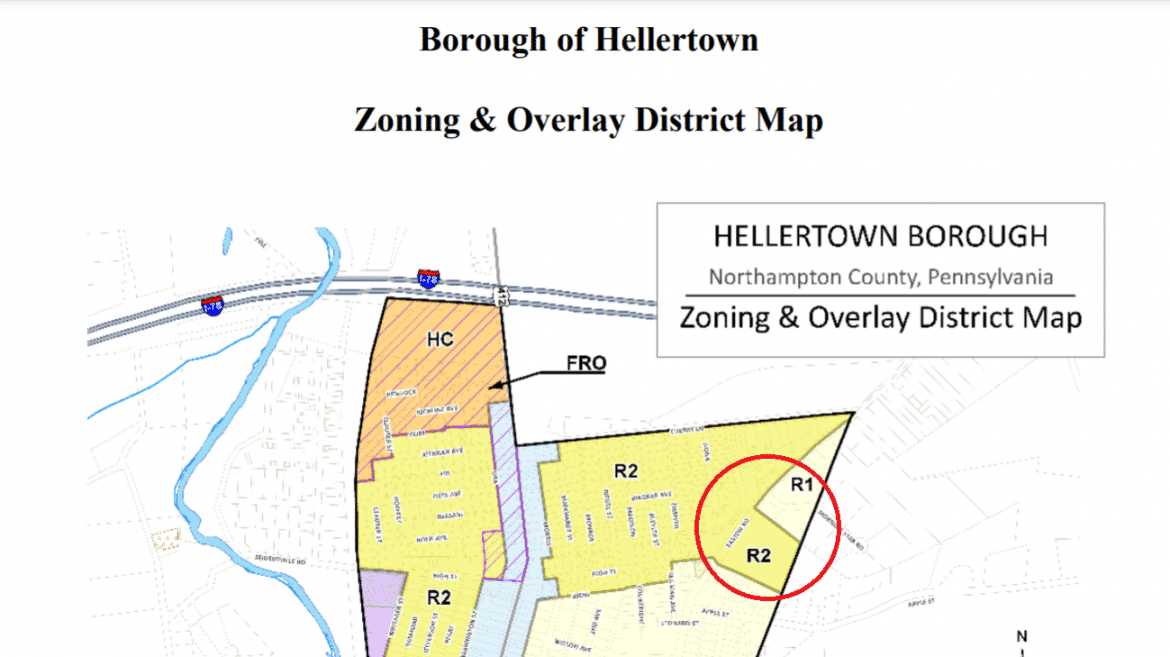
Members of the Hellertown Zoning Hearing Board narrowly voted Wednesday night to grant an appeal of a controversial decision by Hellertown Borough Council to rezone a portion of a property on Easton Road.
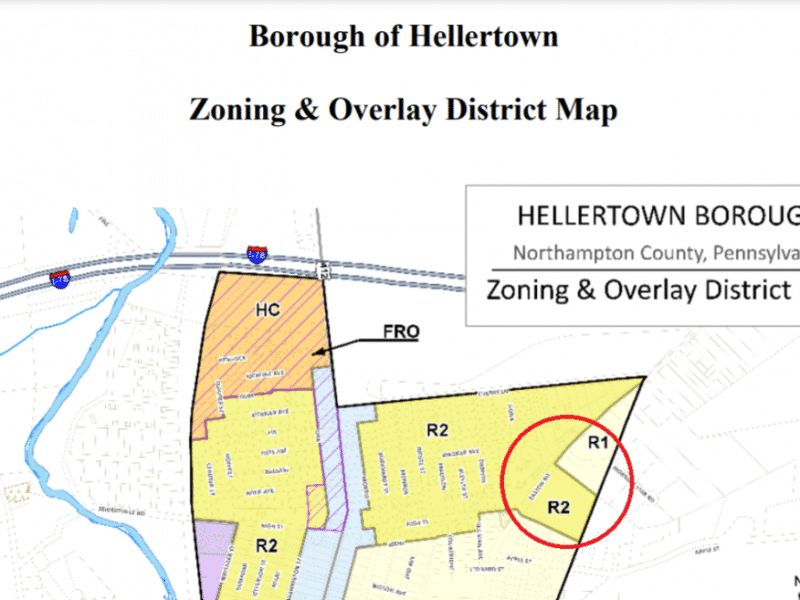
Members of the Hellertown Zoning Hearing Board narrowly voted Wednesday night to grant an appeal of a controversial decision by Hellertown Borough Council to rezone a portion of a property on Easton Road.
Wednesday’s zoning hearing board meeting was the third continuation of the appeal hearing, which began in May and was initiated by a group of property owners who live in the area of the Easton Road property, which straddles the Lower Saucon Township line.
Neighboring property owners had appealed a court ruling that restored a January 2020 ordinance, which changed the zoning status of the property at 1527 Easton Road from R-1 to R-2; a zoning classification that would allow for higher density housing to be built on it.
The January 2020 zoning ordinance came under additional scrutiny after Hellertown Mayor David Heintzelman exercised a seldom-used mayoral veto to reverse council’s rezoning decision. The owners of the property appealed that reversal and the Northampton County Court of Common Pleas sided with them, overturning Heintzelman’s veto and reinstating the R-2 rezoning in August 2020.
The first two sessions of the appeal hearing included a combined total of nearly eight hours of deliberation and testimony from both the borough and the neighbors who appealed the court’s decision to the zoners. Wednesday’s meeting consisted of closing arguments by both sides, which were followed by the zoning hearing board’s deliberation.
An attorney representing the neighbors, Matthew Deschler, summed up his clients’ position that the rezoning decision constituted spot zoning by arbitrarily singling out the 6.7 acre property at 1527 Easton Road, which is owned by Michael and Sarah Chaffier.
“The zoning ordinance that was passed in January of 2020 does single out the Chaffiers’ property where there are not any distinguishing characteristics between that property and the surrounding properties that all had been, previously, R-1,” Deschler argued.
He added that prior to the adoption of the January 2020 zoning ordinance, Easton Road served as a natural boundary between the borough’s R-1 and R-2 zoning districts.
“Doesn’t it make sense to have that line be a state route–as Easton Road is–as opposed to in your backyard, the way it’s been changed now?” Deschler asked board members.
Deschler challenged a borough argument in defense of the January 2020 rezoning, that it was made in an attempt to advance the welfare of the borough and its residents.
“You would think that if it promoted the public interest, there would be someone else from the public besides the Chaffiers who have come out to advocate for it,” he said.
Deschler also said the R-2 rezoning is in some ways inconsistent with the 2009 Saucon Valley Multi-Municipal Comprehensive Plan. The law stipulates that such inconsistencies alone aren’t grounds to overrule a decision, however Deschler argued that the inconsistency with the plan should be factored in when the board made its decision.
Attorney and borough council solicitor Michael Corriere, who represented the borough in the appeal hearing, responded that in two prior zoning appeal cases, arguments over inconsistencies with municipal comprehensive plans failed. He argued that Hellertown’s Zoning Hearing Board should not consider the inconsistency when making their decision.
Corriere also contended that the rezoning didn’t constitute spot zoning due to there being R-2 zoning in close proximity to the Chaffiers’ property, on the other side of Easton Road.
“Within the surrounding circumstances, there were a number of developments that were townhouses and/or apartments,” Corriere said. “Stonewood Townhouse development was 114 feet from the Chaffier property, Oak Ridge was 298 feet and there were various other townhouses that were presented by (Zoning and Codes Officer) Mr. (Kris) Russo.”
Corriere argued that the rezoning would not create an R-2 “island” at 1527 Easton Road, due to the fact that the property is directly bounded by R-2 housing across Easton Road.
He also reiterated the borough’s position that the zoning ordinance advanced the welfare of Hellertown and its residents by creating an opportunity for a developer to potentially satisfy an increased need for housing, whose development would increase the borough’s tax revenue.
He recalled testimony from Hellertown’s zoning officer and the borough’s engineering consultant, who noted that in recent years there has been an increase in townhouse development, which is only permitted by right in the R-2 zone.
“There have been five twin home developments since 2015, five single-family developments and 14 townhouse developments, so what does that evidence indicate?” Corriere asked.
He referenced testimony from the appellants’ own witness, a licensed realtor named Joseph D’Ambrosio, who said he believed the addition of townhouses would serve as a benefit to the community because they would generate additional real estate tax revenue.
Following closing arguments, the members of the zoning hearing board decided to deliberate in public after a motion to deliberate in a closed, executive session failed by a vote of 2-3.
The five members spent the majority of their deliberation period discussing whether or not they felt the Chaffier property was singled out, and if so, whether the zoning change could be justified as advancing the welfare of the borough.
The majority of the board was in agreement that the property at 1527 Easton Road was seemingly singled out, citing the R-1 zoning status of the properties directly to its north and south as evidence of that.
Members were split, however, on whether or not they believed the rezoning decision had advanced the welfare of the borough.
Member Thomas Dietrich said he felt the rezoning did not advance the welfare of the community, echoing Deschler’s observation that nobody from the public other than the Chaffiers and/or their representatives had shown up to voice support for the ordinance.
Member Larry Sutton disagreed, arguing that clustering new residents together, such as by building townhouses on the property, would allow the borough to expand its tax base without putting a strain on its municipal services like fire, water and sanitation.
Following nearly an hour and 15 minutes of deliberation, member Ken Solt motioned to grant the appellants’ appeal, which would overturn the January 2020 zoning ordinance and restore the Chaffiers’ property to an R-1 status.
The motion was seconded by member Kristina Fish, and was passed by a subsequent 3-2 vote with Solt, Fish and Dietrich voting in favor of granting the appeal, and Sutton and Marina Brekhounets voting to deny the appeal.
The appellants and their supporters applauded the ruling.
If the zoning hearing board’s decision is appealed by the Chaffiers and their attorneys, the matter will be returned to the Northampton County Court of Common Pleas.